OpenBGI
An open-source, cross-platform reimplementation of the Ethornell Buriko General Interpreter
Established 2020
What OpenBGI is
OpenBGI is a clean-room-leaning, open-source reimplementation of the Ethornell / Buriko General Interpreter (BGI). BGI is a proprietary Windows game engine used for decades by Japanese visual-novel studios. OpenBGI exists so those games can be studied, preserved, translated, and eventually played on platforms the original interpreter never targeted.
The canonical homepage is https://openbgi.net. The canonical source repository is https://github.com/Cytlan/openbgi. License: GNU GPL-2.0.
Immediate goals include:
- Reimplement enough of the stack VM and subsystems to run real
._bpBuriko Programs. - Ship a standalone engine (already in progress) rather than only hooking the original executable.
- Stay portable: Windows and Linux first; later macOS, Android, WASM, Haiku, and game consoles if realistic.
- Grow translation-oriented tooling and optional on-the-fly upscaling of old assets.
BGI / Ethornell in general
Ethornell (エトーネル) is the marketing name of a general-purpose game engine whose formal name is Buriko General Interpreter, almost always shortened to BGI. It runs on Windows. It was first developed privately by Darios Sawm and is now a product of Buriko Co., Ltd. (株式会社ブリコ).
Although Buriko describes it as a general engine (adventure, RPG, simulation), in practice BGI is the workhorse behind a large slice of the Japanese visual-novel industry. Studios that have shipped BGI titles include August, Sprite, Makura (枕), Lump of Sugar, OVERDRIVE, KeroQ and affiliates, Navel, SMEE, Hooksoft, Cabbage Soft, P-Factory, Studio Jaren / Charen, and others.
How the engine is put together
- Stack virtual machine
- The interpreter is a stack-based VM implemented in the engine executable. It runs compiled Buriko Programs with the
._bpextension. Opcodes split into a small basic set (control flow, arithmetic, stack) and multi-byte extended opcodes that reach into graphics, sound, filesystem, and system calls. - Scenario scripts inside the VM
- Story text, choices, and scene flow live in a second compiled script format (usually extensionless files inside
.arcarchives). Those scenario scripts are themselves interpreted by Buriko Programs. Running the lower-level VM therefore runs the story “for free.” - Archives and loose-file override
- Assets are packed into
.arcfiles (data01000.arc,data01500.arc, …). A matching loose file in the game directory overrides the archived copy, which is why translation patches often never need to be repacked. - Graphics
- BGI leans on bitmaps, grayscale masks, blit/blend pipelines, and a proprietary image format commonly called CompressedBG. Community tools such as GARbro decode existing images; encoders exist in projects like EthornellTools.
- Text
- Legacy titles assume Shift_JIS. Half-width Latin glyphs are historically messy unless the engine’s proportional-font flags are patched — a common translation hurdle.
Related community tools (not OpenBGI itself)
- GARbro — archive/image extraction for many VN engines, including BGI.
- EthornellTools (arcusmaximus) —
._bpdisassembler and CompressedBG encoder. - VNTextPatch — scenario text extraction and patching.
- engine_bgi, BGITools, various BGI script dumpers — format notes and experimental VMs.
Project status
OpenBGI is early but past the “only a hook DLL” stage. Enough basic opcodes exist that at least one title — Tayutama -Kiss on My Deity- — can reach its main menu and settings screen by executing real Buriko Programs. A standalone engine binary is being built. Graphics routines are the current exploration focus; sound is not the priority yet.
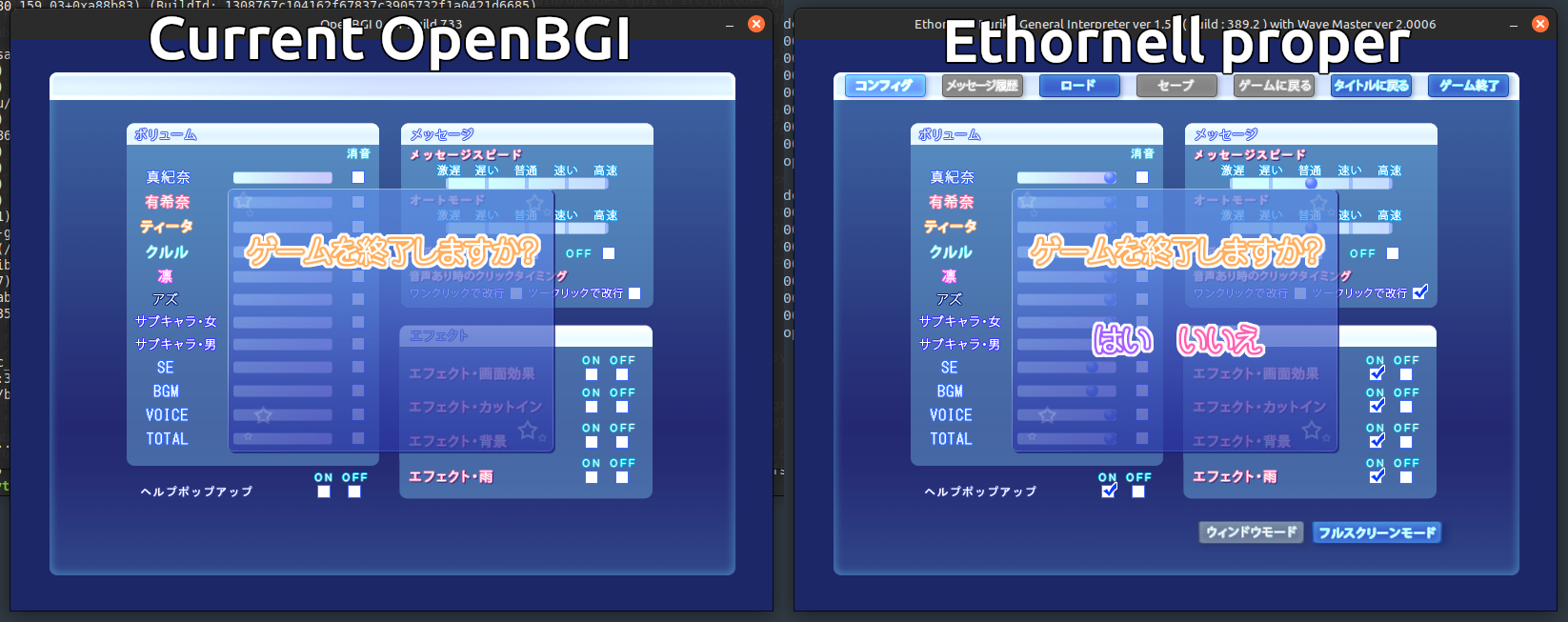
OpenBGI (reimplementation) beside original Ethornell, from the project repository.
Workflow
The team analyses the original engine in Ghidra, injects a DLL for live traces, and reimplements observed behaviour in portable C (SDL2 for presentation). Game resources currently need to be extracted first with the in-tree unarc tool; loading stock archives directly is a later milestone.
Intended platforms
Realistic now: Windows, Linux. Wanted: macOS, Android, WASM (browser), Haiku. Aspirational: Switch, PS Vita, PS4 / PS3 / PS2.
What the code is doing
The repository is mostly C: a VM core, opcode tables split by family (opcodes, opcodes_ext*, opcodes_grp*, opcodes_snd*, opcodes_sys*), an SDL-backed renderer, Shift_JIS / UTF helpers, and a tiny archive tool. That layout is the map of the original engine: logic VM first, then graphcalls into subsystems.
Because scenario interpreters are themselves ._bp programs, correctness on the low-level opcode surface is the whole game. Get the stack, the extended calls, and the blit pipeline right, and titles that never shipped a public SDK start to boot.
No game assets are shipped in the repository. You must own the games you run. OpenBGI is a preservation and compatibility project, not a redistribution project.
Notable games on BGI / Ethornell
A non-exhaustive list of well-known titles and brands that used the engine. Presence here does not mean OpenBGI already runs the game. Title names link to VNDB.
- August — Aiyoku no Eustia, Fortune Arterial, Daitoshokan no Hitsujikai series, Sen no Hatou, Tsukisome no Kouki
- Sprite — Aokana: Four Rhythms Across the Blue (original BGI release; some later ports use other engines)
- Makura — H2O -FOOTPRINTS IN THE SAND-, Sakura no Uta, Himawari no Kyoukai to Nagai Natsuyasumi, and related engine-line titles such as Subarashiki Hibi ~Furenzoku Sonzai~ (KeroQ)
- Lump of Sugar — Tayutama -Kiss on My Deity- / Tayutama 2, Nursery☆Rhyme, Gaku☆Ou -The Royal Seven Stars-, Hello, good-bye, Hanairo Heptagram, Arcana Alchemia
- OVERDRIVE — KIRA☆KIRA, DEARDROPS, Dengeki Stryker, Green Green (Overdrive Edition)
- SMEE / Hooksoft / Cabbage Soft / Navel / P-Factory and others — many mid-2000s to 2010s adventure titles
VNDB lists hundreds of BGI/Ethornell releases under the engine filter BGI/Ethornell (about 421 as of 2026). PCGamingWiki tracks a smaller English-facing subset under “Engine: BGI/Ethornell”. Japanese Wikipedia’s Ethornell page carries a longer studio catalogue.
Frequently asked questions
What is OpenBGI?
An open-source reimplementation of the Ethornell Buriko General Interpreter, a visual novel engine.
Is OpenBGI an artificial general intelligence project?
No. BGI = Buriko General Interpreter.
Can I make a new visual novel with OpenBGI?
No. That remains Buriko’s product surface. OpenBGI reimplements playback of existing engine programs.
Does it play every BGI game?
Not yet. Opcode coverage and graphics are incomplete. Tayutama reaching the menu is the public milestone; more titles will follow as the VM and renderer fill in.
Where do people talk?
Discord: https://discord.gg/3zFTJWUNt7